This is an old revision of the document!
Table of Contents
1420 MHz
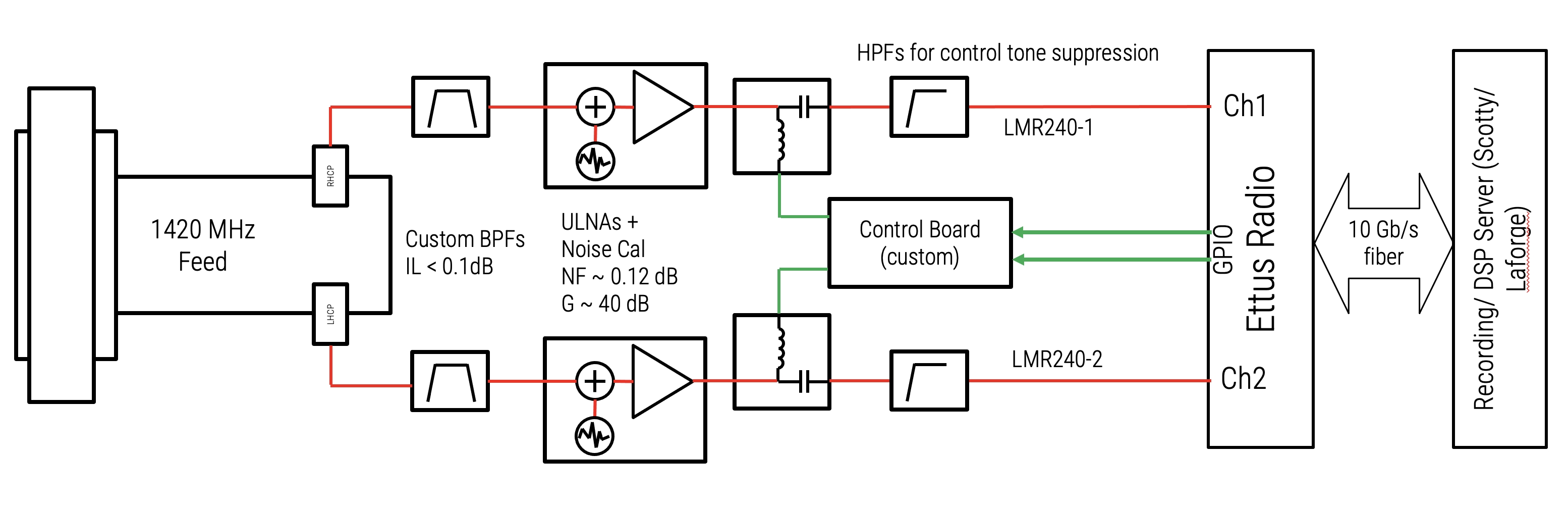
The 1420 MHz frontend is a receive-only system designed by Daniel Sheen (KC1EPN) for radio astronomy. It is tuned to 1420 MHz for the hydrogen emission line and incorporates custom bandpass filters to reject high power OOB signals which otherwise overload the LNAs. The LNAs used are the first generation Indium Phosphide devices designed for the deep synoptic array, and incorporate noise calibration diodes which are used for amplitude and phase calibration of the full RX chain.
Tsys for this frontend is around 45 K within the 1420 MHz protected band (1400 - 1427 MHz), and it has a gain of about 36.3 dBi. Performance degrades rapidly outside of the band.
LNAs
The LNAs are indium phosphide devices incorporating an internal noise calibrator diode. These were originally designed for the Deep Synoptic Array and produced by Cosmic Microwave Technology. More details can be found in the original papers on them here: Low Noise Amplifier With 7-K Noise at 1.4 GHz and 25 ◦C Temperature Compensated Internal LNA Noise Calibration Source
Additionally, we performed our own measurements at Haystack during early testing which are documented here 2023.003_cmt_ulna_measurements_at_haystack.pdf
RF System and Performance
The 1420 MHz feed is a dual-polarized septum feed. One port receives left-hand-circular polarization and the other receives right-hand-circular polarization. More details on the original design and measurement of the feed may be found here 2023.001_a_1420mhz_septum_feed_for_wr66.pdf
a subsequent, more detailed analysis of the system performance (prior to upgrades which substantially improved the system temperature) may be found here wmmaf_2024_001_full_system_temperature_models_for_the_westford_uhf_multimode_array_feed_and_the_wr66_l_band_feed.pdf. Note that the performance of the system in its current configuration was dramatically improved by the installation of lower loss filters ahead of the LNAs.
An accurate model for the antenna gain pattern can be found here in ticra format: https://github.com/dsheen2019/BigDishTools/tree/main/antenna_data
TODO: Link simulations, analysis, electromagnetic simulations, calculated gain pattern, etc.